

Canine parvovirus (CPV) is a non-enveloped, single-stranded DNA virus belonging to the genus Dependoparvovirus within the family Parvoviridae. The virus was first identified in 1978 and primarily infects canids, serving as a significant pathogen causing viral enteritis and myocarditis in puppies. CPV is widely distributed among canine populations globally, exhibiting high transmissibility through direct contact or indirect transmission via contaminated environments. The virus demonstrates strong environmental stability and is prone to antigenic variation, leading to the emergence of multiple antigenic types (e.g., CPV-2a, CPV-2b, CPV-2c, etc.). This highlights the importance of epidemiological surveillance and research into prevention and control strategies.
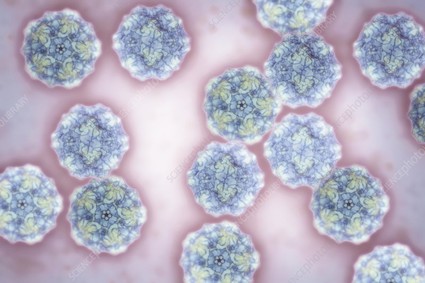
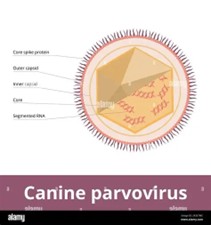
Canine parvovirus belongs to the family Parvoviridae, and its viral particles exhibit an icosahedral symmetrical structure with a diameter of approximately 18–26 nm, making it one of the smallest known animal viruses. The viral genome is a linear single-stranded DNA, approximately 5.3 kb in length, containing two major open reading frames that encode two non-structural proteins (NS1, NS2) and two structural proteins (VP1, VP2). The entire viral particle primarily consists of a protein capsid, which is assembled from 60 copies of VP1 and VP2 proteins in specific proportions. Among these, VP2 is the major component of the capsid, accounting for about 90%. The VP2 protein determines the antigenic properties and host range of the viral particle, with variations in key amino acid sites on its surface closely associated with the virus's adaptability to different hosts and changes in antigenicity. The canyon-like structure formed on the surface of the viral capsid serves as a critical region for binding to the host cell surface transferrin receptor (TfR), mediating viral attachment and internalization. The interior of the viral particle contains the genomic DNA and a small amount of VP1 protein, which may be involved in the packaging and release of the viral genome. The structural characteristics of the CPV capsid protein and its specific recognition mechanism with host receptors provide an important theoretical foundation for viral detection technologies, vaccine design, and antiviral research.
Our company provides a comprehensive range of antigens and antibodies for canine parvovirus.
【Antigens】
| Product Name | Catalog# | Contact |
| NebuSelect™ Recombinant CPV-2 Capsid protein VP2 Protein, 188-727aa, His-tag | NBL-291833 | ☎ Technical Support >> |
| NebuSelect™ Recombinant CPV-2 NS1 Protein, 276-556aa, His-tag | NBL-291834 | ☎ Technical Support >> |
【Antibodies】
| Product Name | Catalog# | Contact |
| NebuSelect™ Anti-CPV2/FPV Capsid protein VP1 Antibody | NBAB-194514 | ☎ Technical Support >> |
| NebuSelect™ Anti-CPV Capsid Antibody | NBAB-194515 | ☎ Technical Support >> |
| NebuSelect™ Anti-CPV-2 NS1 Polyclonal Antibody | NBAB-194516 | ☎ Technical Support >> |
| NebuSelect™ Anti-CPV-2 Capsid protein VP2 Antibody | NBAB-194517 | ☎ Technical Support >> |


