

Herpes Simplex Virus Type 2 (HSV-2) belongs to the family Herpesviridae and the subfamily Alphaherpesvirinae. It is an enveloped virus with a linear double-stranded DNA genome. This virus is widespread globally and is one of the most common pathogens in humans, characterized by high host specificity and neurotropism. HSV-2 is primarily transmitted through close contact, and its most notable biological feature is the establishment of lifelong latent infection in the host. After initial infection, the virus invades local sensory nerve endings and undergoes retrograde axonal transport to neuronal cell bodies in sensory ganglia, such as the sacral ganglia. There, the viral genome persists in a latent state as a circular episome in the nucleus, with minimal expression of viral proteins, thereby effectively evading recognition and clearance by the immune system.
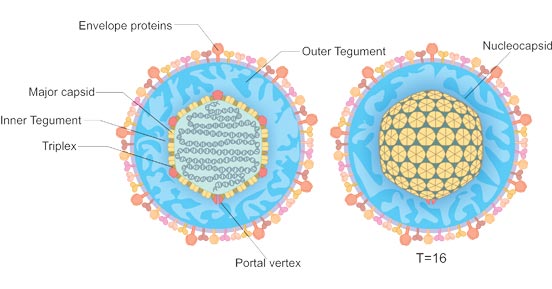
The HSV-2 virion exhibits the typical complex multilayered structure of herpesviruses, with a diameter of approximately 150–200 nm. From the inside out, it consists of four main components: the core, capsid, tegument, and envelope. The innermost core contains the linear double-stranded DNA genome, which is about 154 kb in length and encodes at least 74 different proteins as well as various non-coding RNAs. The genomic sequence shares approximately 50% homology with HSV-1 but displays significant differences in specific regions, which influence the virus's cellular tropism and immunogenicity. The genome is enclosed within an icosahedral nucleocapsid composed of 162 capsomeres, measuring about 125 nm in diameter. This stable capsid structure is assembled from major capsid proteins such as VP5, VP19C, and VP23. Surrounding the nucleocapsid is an amorphous protein layer called the tegument, which contains multiple proteins critical during the early stages of infection, including the potent transcriptional activator VP16 and large molecular complexes like UL36 and UL37, involved in viral genome release. The outermost envelope is derived from the host cell's nuclear membrane and is embedded with at least 12 virus-encoded glycoprotein spikes, including gB, gD, gH/gL, and the highly specific gG-2. These glycoprotein complexes play a central role in viral attachment, fusion with the host cell membrane, and direct cell-to-cell spread, serving as primary targets for neutralizing antibodies.
Our company provides a comprehensive range of HSV-2 antigens and antibodies.
【Antigens】
| Product Name | Catalog# | Contact |
| NebuSelect™ Recombinant HSV-2 gD/US6 Protein, 26-339aa, GST-tag | NBL-292039 | ☎ Technical Support >> |
| NebuSelect™ Recombinant HSV-2 gD/US6 Protein, 26-339aa, His-tag | NBL-292040 | ☎ Technical Support >> |
| NebuSelect™ Recombinant HSV-2/HHV-2 gC/UL44 Protein, 27-447aa, His-tag | NBL-292041 | ☎ Technical Support >> |
| NebuSelect™ Recombinant HSV-2/HHV-2 gC/UL44 Protein, 28-447aa, His-tag | NBL-292042 | ☎ Technical Support >> |
| NebuSelect™ Recombinant HSV-2/HHV-2 gG/US4 Protein, 525-578aa, GST-tag | NBL-292043 | ☎ Technical Support >> |
【Antibodies】
| Product Name | Catalog# | Contact |
| NebuSelect™ Anti-HSV-2/HHV-2 gB/Envelope glycoprotein B Antibody | NBAB-194776 | ☎ Technical Support >> |
| NebuSelect™ Anti-HSV-2/HHV-2 gD/Envelope glycoprotein D Antibody | NBAB-194788 | ☎ Technical Support >> |
| NebuSelect™ Anti-HSV-2/HHV-2 gC/UL44 Polyclonal Antibody | NBAB-194790 | ☎ Technical Support >> |
| NebuSelect™ Anti-HSV-2/HHV-2 gG/US4 Polyclonal Antibody | NBAB-194791 | ☎ Technical Support >> |
| NebuSelect™ Anti-HSV Glycoprotein B/gB Antibody | NBAB-194772 | ☎ Technical Support >> |
| NebuSelect™ Anti-HSV Glycoprotein B/gB Nanobody | NBAB-194778 | ☎ Technical Support >> |


